

FLCL: SHOEGAZE
STATUS
COMPLETE
EPISODES
3
RELEASE
October 15, 2023
LENGTH
23 min
DESCRIPTION
The fifth season of FLCL, and successor series to FLCL: Grunge. The anime will take place 10 years after FLCL Alternative and will center on a high school boy and girl.
Masaki, who's been having a hard time fitting in with his class due to his unique background and character, meets Harumi, who is even more eccentric than he is. She offers to help him off of his worries by bombing the Tsuganei Tower.
(Source: Anime News Network, Adult Swim, edited)
CAST

Harumi Araishu

Satomi Amano

Masaki Aofuji

Shouya Chiba

Kana Koumoto

Karen Miyama

Hijiri Yajima

Riho Iida

Man Motoyama

Mutsumi Tamura

Tsukata Kanda

Yutaka Aoyama

Haruko Haruhara

Tomomi Hetada
EPISODES
Dubbed
Not available on crunchyroll
RELATED TO FLCL: SHOEGAZE
 ANIME ActionFLCL: Grunge
 ANIME ActionFLCL Alternative
REVIEWS

Pockeyramune919
FLCL finishes off strong in an entry that once again validates the sequel seasons.Continue on AniList[
 ](https://anilist.co/review/22680)
_Part 5⁄5 of the FLCL Review Series_ 
To say Grunge was a disappointment to the fanbase at large would be an understatement. Grunge was on thin ice from its teaser trailer and the show itself won very few fans. Even as a member of the FLCL Sequel Defense Squad, I have trouble defending it, let alone actually recommending it.
But that's only half the story.
Like 2018's FLCL: Progressive before it, 2023's FLCL: Grunge was announced alongside another season, FLCL Shoegaze, the fourth and, as of this writing, final FLCL sequel. Like its older sibling, information on Shoegaze was sparse. By June of this year, over a year after its announcement, we didn't have so much as a still. Come July, we at least had a trailer shown off during the Adult Swim festival and it showed more traditional animation compared to Grunge.
This wouldn't quite be enough to turn the tide on Shoegaze, however. Grunge's abysmal reception meant that, by the time Shoegaze rolled around, there were few eyes left willing to give it a glance. It's telling that people couldn't post their negative reviews of Grunge fast enough while there were crickets in Shoegaze's review section prior to me moseying along.
History has a tendency to rhyme and so, I'm left breathing the same sighs I did four years ago. It's a damn shame that many have passed over Shoegaze because it's a story worth telling. It's a strong show that's more than meets the eye. Like Alternative, it's a worthy sequel to the 2000 classic, not only working as a sequel, but stands tall as a solid show in its own right.

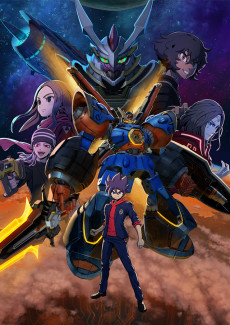
FLCL Shoegaze tells the story of Masaki Aofuji and Harumi Araishu, two teenage outcasts who feel alone and adrift in the world. They focus their frustrations and confusion at the world towards the mysterious Tsugenei Tower atop which a giant, glowing bird only Masaki can see roosts. The rebels without a cause break into the facility with eyes to cause mischief. They might find more than they bargained for, but it's worth it if they can make sense of their places in the world in the process.
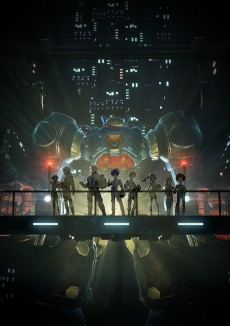
First thing up on the review block is animation. For both Shoegaze's sake and my own sanity, I'm happy to say the animation is fine. It's leaps and bounds better than Grunge's which ultimately isn't saying much, but it goes a long way in making it easier to engage with the show. Like FLCL: Alternative before it, Shoegaze moves away from the style shifts and high octane animation that was the original's bread in butter. Out of the sequels, it's the one that's moved the furthest away from the original's animation philosophy; if there was a style shift in Shoegaze, I certainly don't remember it. If you think FLCL lives and dies by its animation, then you probably won't be picking up what Shoegaze is putting down. If you've stuck with this entire review series ("Look at me ma, I've got fans!"), you know that animation isn't my end all, be all for judging a work, even FLCL. And for what it's worth, the art is still moody and atmospheric. For all that Shoegaze diverges from the original, don't let anyone convince you it's not at least quite pleasant to look at. There might not be much more to say about the art beyond that, but given the dissertation I had to write about Grunge's animation, I'm happy for it.

Then there's the music. While I liked Grunge’s OST, I didn't have anything new to say about it compared to previous seasons. I'm pleasantly surprised to find that isn't the case here. For one, the songs feel a lot more impactful here than they have in seasons. I can distinctly recall what songs played during pivotal moments. I was particularly ecstatic at hearing "Split Emotion" during the first episode, since it's a Pillows song I've loved for years and thought would fit great in FLCL. And it does! Starry Fandango's use in the second episode is also amazing and it's quickly gone into my song rotation. What helps elevate the soundtrack even more is the fact that all the songs are apparently new. It goes a long way in giving Shoegaze its own identity separate from Classic.
Next up, we have the characters. Before we continue, dear reader, I want you to look at that premise again. You may notice a certain, conspicuous omission. No, I didn't strategically leave her out. Ladies, gentlemen, everyone in-between, and everyone beyond, Miss Haruko Haruhara has left the building. Spoiler alert, her exit isn't a temporary leave of absence, either. She doesn't show up at the end; as of this writing, Haruko's last appearance is in FLCL: Grunge.
It's certainly a bold move. One of the most pervasive criticisms of the sequels has been that it doesn't feel like the original and one of the biggest connections between them and Classic has been Haruko herself.

Bold as it is, I think it worked out surprisingly well. The lack of Haruko, like the new OST, gives Shoegaze its own identity. It certainly helps that Haruko's presence has felt more and more superfluous with each sequel. For as many problems as Progressive has, you can't say that it doesn't utilize Haruko and her other half to the most of its ability. I certainly like how Haruko is used in Alternative and she brings a lot of color to the anime, but she plays a lot less of a central role before. And in Grunge, she actively steals the focus away from the cast who needed it more. And I also like what Haruko's absence does for the series metatextuality. It goes a long way in highlighting the shows' themes of growing up and accepting change.
With Haruko nowhere to be found, a big part of your enjoyment of the show will boil down to how you feel about the leads.

On paper, Masaki and Harumi aren't anything to write home about. Masaki's ability to see ghosts isolates him from others, making him withdrawn and antisocial. He's a loner, one you've doubtless seen before. It's a well-worn archetype at this point, especially in animanga. As such, the reasoning for their status as a loner is what makes or breaks this type of character. Taken literally, Masaki’s plight hard to relate to (at least for me, if you can see ghosts, then you'll love theguy). Taking his plight to be more figurative — that seeing ghosts being a stand-in for being different — doesn't work well either. Masaki being a loner for being different makes sense for the story, but it doesn't do much to make him unique. "Loner" characters can be the perfect avatar for those who feel like outcasts, but it doesn't do much to make them feel like actual characters — relatable but shallow. This is essentially how Masaki comes across at first — pandering at best, flat at worst.
Then there's Harumi. She's a distinct character, but if you've been following FLCL since Classic, with her zany personality, you get the sense that she's supposed to be somewhat of a stand-in for Haruko. I was surprised to learn that Harumi isn't voiced by Kari Wahlgren because she sounds like Haruko, too. My initial impression of Harumi, particularly given the show's focus on Masaki, was that she was somewhat of a Manic Pixie Dream Girl. There's certainly more to her than this — she has her own goals, has a compelling reason for feeling like an outsider and she gets genuinely frustrated at Masaki early on — it's just that, at the beginning it's hard to predict how interesting she'll end up being.
All that said, our two leads initially come across as more simple and plain than bad. The journey they embarked on was at least interesting enough to hold my attention even if they themselves didn't.

A character who did grab my attention was our third lead, one returning Kana Koumoto. I was somewhat wary to see her return at first, as I wasn't sure if Shoegaze would do the protagonist of my favorite FLCL justice. I'm pleased to say it did. Kana's appearance isn't just a callback. Instead, the exploration of her character is so central to the identity of Shoegaze that it serves as a stealth sequel to to Alternative. Alternative, like other FLCL seasons, dealt with growing up. Through Kana Shoegaze explores what it means to have grown up and how people grapple with the future not being what they wanted. Gone is Kana's bubbly exuberance that hid her fears over the future; Kana has grown up and the result is stark. Kana has to deal with feelings of inadequacy due to failing to live up to both her own expectations and those of others. She does her best while not really knowing what she's doing due to feeling like a puppet on a string. She’s drawn to the past, lacking hope for the present while barely having the energy to think of the future.

Once again, I found Kana immensely relatable and I'm sure many others will as well. Her plight is the perfect way to continue her story from where we last saw her. It feels like I grew up with her and she's navigating the world with me. Her arc in Shoegaze is very inspiring. It also works well for the story, with her decision to move on from the past and unshackle herself from expectations contrasting nicely with antagonist Tsukata's dogged attempt to "get back to the way things were."
At first, I thought Kana stole the show from the other two leads and while I certainly still find her the most consistently compelling of the three, in hindsight, instead of stealing their thunder, her presence helps the other two leads shine.

This is mostly due to how they contrast with Kana, being a snapshot of the current generation and how they interact with those who came before. As expected, Masaki and Harumi clash with Kana and Tsukata. What's more interesting is the way that Harumi's free-spirit serves as the catalyst for Kana's arc — showing that the older generation can still learn and grow in part with help from those who come after them.
Kana might be my favorite of the trio, but Harumi is solidly in second place. They're interesting to watch and what's more interesting is their identity — FLCL Shoegaze introduces the idea of alternate universes. In Harumi's original world, they are a boy (complete with a different voice actor) while they seemingly turn into a girl upon finding themselves in the world where most of the action of Shoegaze takes place. No matter what you interpret their true identity as, there's certainly a lot to chew on and analyze, even for such a short show. This ends up making them one of the deeper main characters the series has offered and the perfect icon for a new generation of viewers to impart their complicated identities on while not feeling like a blank avatar. It's a bit reductive, but I think one of my favorite aspects of their character is their relationship with Masaki and how he seemingly still loves them when he discovers they’re a boy in their home universe.

Speaking of which, there's Masaki. Honestly, even after finishing the series, he's still the weakest of the three, but there's something to be said about how he and Harumi bounce off one another. They're obstensibly a pretty simple pairing but, it's fresh to see in the context of FLCL. Relationships in FLCL have ranged from fraught, to predatory, to underbaked so it's nice to not only see mutual, fleshed-out attraction. In Shoegaze we perhaps see the healthiest depiction of love and desire in the entire series. At the climax of Shoegaze, a shocked Tsukata remarks that Masaki's N.O. isn't fueled by lust, but love. It's cheesey, sure, but given the journey to get to this point, it's pretty darn cute.
Speaking of lust, we get to one of my few critiques — the fan service. FLCL is no stranger to horniness ("fooly-cooly" itself probably means to fool around), but to my knowledge, Shoegaze lays on the ecchiness the thickest with multiple shots of Harumi's panties, cleavage, etc. If one isn't a fan of ecchi, they might find Shoegaze offputting, especially as it seems to come pretty far out of left field in the context of the series…
...and yet…
...I think, and I know I sound crazy here, these shots aren't that gratuitous? Sure, they're groan-inducing, but given how they're framed, it's very clear that they're moreso to show what Masaki is looking at and less for the audience to leer at Harumi independent of the characters. The closeups aren't strictly necessary for this purpose, I’m aware, but I do think the directors didn’t add them for their own lecherous pleasure. I know it just sounds like I'm in too deep, but while I recognize this as unnecessary fanservice, I can also say that I've seen much worse.

Then there's the ending. It probably raises more questions than it answers, but I think that just comes with the territory at this point. Like pretty much all FLCL endings, it might not be the most satisfying in terms of world-building, but it does right by it's characters and since the beginning, I've found that more important. How it does right by them might strike some people as being a bit too sweet on the bittersweet side. Masaki gains the ability to travel between worlds by harnessing the power of Atomsl, being able to both see Harumi again and helping connect Kana with Pets after ten years. I have mixed feelings about the ending, too, but I ultimately think after seasons of bittersweet endings, a more unequivocally happy ending is earned — growing up doesn't always have to be painful and you don't have to let go of everything you loved as a child. After all, I'm still here, enjoying FLCL, just in a different manner than I did all those years ago.

As of this writing, there are no plans to release more seasons of FLCL. My feelings about finally closing the door on FLCL are complicated, but ultimately, I'm glad that we got to end on Shoegaze. It's the most uplifting of the FLCL seasons and builds on my favorite season to create something truly special. No matter what detractors say, it's hard to deny that Shoegaze wasn't made with care and understanding of why FLCL Classic resonates with people all these years later. With that in mind, I think this is a great place to end. While I'll be the first to watch yet another FLCL sequel, this is a good chapter to close the book on a series that has meant a lot to me as an anime fan.


If nothing else, I hope this review series helped at least one person give FLCL a try or another look. And when I say FLCL, I don't just mean the original, but the series. FLCL is a classic for a reason, but many more eloquent writers than I have and will continue to recommend it. The FLCL sequels, mostly through Alternative and Shoegaze, are hidden gems that deserve more eyes on them. They're aren't exactly like Classic, but they never needed to be, were never meant to be. It's in the title — they're a different way to portray the themes of what made the original such a classic. And an alternative take of "great" is still "great."
SIMILAR ANIMES YOU MAY LIKE
 ANIME ActionKill la Kill
 ANIME ActionFLCL Progressive
 OVA ActionTop wo Nerae 2! DIEBUSTER
 ONA ActionGodzilla: Singular Point
 ANIME ActionMecha-ude (TV)


SCORE
- (2.95/5)
TRAILER
MORE INFO
Ended inOctober 15, 2023
Main Studio Production I.G
Favorited by 81 Users