MESH
STATUS
COMPLETE
VOLUMES
8
RELEASE
June 1, 1984
CHAPTERS
12
DESCRIPTION
The story follows the life of a teenage boy named "Mesh," so-called for his unique "mesh"-colored hair: blonde with silver strands on the sides. It begins with a scene where Mesh, after being beaten, escapes from a mob and encounters Milon, a forger and painter. Mesh ends up staying at Milon's house, and the two form an unlikely bond as they navigate life together. Each chapter is a poetic blend of crime, peaceful everyday moments, or the vibrant nightlife of artists in a fictionalized Paris.
Mesh is regarded as one of Hagio Moto's defining works, marking a pivotal shift in her artistic style. It was her first series to adopt a more realistic look while retaining the ethereal beauty characteristic of 1970s shoujo art. The story ventures into more mature themes while continuing to explore Hagio's recurring motifs, such as parent-child relationships and adolescence.
Volume 1:
- Mesh
- Rouge
Volume 2: - Haru no Hone
Volume 3: - Kakumei
- Montmartre
Volume 4: - Mimi wo Katamukete
- Buran
Volume 5: - Sen no Ya
- Nigate na Jinshu
Volume 6: - Shanikusai
Volume 7: - Surreal na Ai no Real na Shi
Volume 8: - Fune
Note: In 2024 a digital only eight volume was released which included the story Fune
CHAPTERS
REVIEWS

cloudyspider
Piercing the flesh, nurturing the grave, unearthing the womanContinue on AniListMesh as a story is concerned with the crystallization of womanhood underneath a layer of nominally unwoman flesh. It is also about Paris, and about art (specifically paintings), sometimes music and theater, occasionally poetry, more frequently it’s about drug-induced fever dreams and general loss of reality, as well as that type of loneliness only achieved by surrounding yourself with other bodies. Most centrally, though, it’s about holding your breath. Given that Mesh is authored by Moto Hagio, it also heavily revolves around sexual abuse and trauma. What I’m writing here will be about the woman part, and also the sexual trauma part. There are spoilers ahead, but honestly anyone who’s familiar with Hagio’s work and the subject matter she tackles likely won’t be spoiled here.

Mesh as a protagonist is unrelentingly abused throughout the entire narrative, contorted against his will into a feminized object always by a larger, older, wealthier, stronger, more formidable masculine figure, who treats him with the same humanity one would treat inflatable plastic sex dolls. On both a physical and psychological level, Mesh is bent and twisted every which way to suit the desires of his abusers, whose continual sexual objectification necessitates the disappearance of any dimension of Mesh’s personal identity. His body is appropriated, and so is his soul, his essence, his nature, and his being. In the act of bodily dispossession, he ceases to exist as a discrete individual. This becomes clear in the second chapter, where Mesh is frantically trying to explain his mission of killing his father (the first man in his life to abuse him), and says this: “Even if I go mad or die, as long as he’s gone, it’s fine. As long as he’s still here, I can’t become a human being. I’ll be crushed by him for the rest of my life” [emphasis mine]. This specific facet of sexual trauma, this deterioration of distinct human personhood, is captured so acutely and so resonantly here. He is impersonalized, sense of self eroded, permanently barred from being perceived as a member of the universal human condition, only permitted existence as the inert, voiceless, brainless, impersonal Thing made for fucking.

The essential condition of Mesh’s suffering, though, and the rationale as to why he is treated the way he is, is that he isn’t a man. His condition is the female condition. The single string which ties it all together is his femininity, or rather, his feminization. This is not a type of feminization observable in any other manga in this tradition (vintage shoujo, year 24, and if I considered myself more knowledgeable about other areas of manga history I’d probably be saying the same thing there). Sure, Kaze to Ki no Uta’s Gilbert and Serge are feminine, Mari to Shingo’s Mari and Shingo are feminine, and even in other Hagio works, Jeremey, Julusmole, Erich etc, but not a single one of them bears the quintessentially female mark of oppression carved into their lives so indelibly and so legibly as it is for Mesh. And I mean this quite literally: a slew of characters repeatedly reiterate to Mesh that he is, in their eyes, a woman. They spell it out clear as day. The question of whether Mesh’s femininity is truly innate is entirely irrelevant because femininity is regardless imposed upon him, forcibly and violently, by outside forces, for various reasons - chiefly as a justification for him being the primary receptacle for their sexual abuse. In fact, the methods through which his trauma is explored are all inextricably entwined (enmeshed. . .) with his gender performance as female. Briefly put, Mesh deserves the sexual violence he’s subjected to because he is a woman. Several characters literally state this! And if it turns out that he isn’t a woman, he will surely become one through this process of sexual violence; ritualized, propagandized, systematically mandated, and specifically designed to orient him towards his rightful position as dominated, and never dominator. If he doesn’t fit adequately into the feminine mold, sexual violence is enforced as a corrective measure, to emasculate, to feminize; to womanize. It actually screams Simone de Beauvoir in the whole “one isn’t born a woman, one is made into a woman” (I obviously can’t prove it, but I’m at least 80% sure Moto Hagio read The Second Sex).

Mesh’s experience with and relationship to womanhood is (regrettably) strikingly similar to my own. In many ways, reading Mesh feels like staring into a mirror that magnifies all of the most shameful parts of myself. I will not throw a pity party for myself here, but the one singular sentiment banging like a gong in my head ever since I was about fourteen is that I didn’t voluntarily become a woman, nor was it ever an essential characteristic of my being, it just so happened that at some point I started feeling less universally human and more like a femininely shaped object, which men started subtly asserting ownership to. At some point, I began to realize that I was being made into a woman. I want to emphasize, I wasn’t becoming one, nor was I ever one to begin with, I was being sculpted into a certain shape, a certain form, being contorted into an unmistakably feminine pose, against my will. Absolutely nothing about womanhood felt natural, inherent, or predetermined, it just felt oddly violent. And ever since, I’ve kind of been trying to rock with it in a fun way and it hasn’t really been working so well but at least I derive enjoyment out of it sometimes, right???? The same thing is happening to Mesh, though, in that he is positioned as a feminized object designed to absorb male violence–he’s literally made into a woman, against his will, sculpted into this form by the violent male hand.

Mesh’s womanization by his abusers is indispensable to and fully obligated by the law of the patriarchal regime: his rapist(s) MUST sexually differentiate himself from Mesh, then inscribe this sexual differentiation into natural law (so that a domination model is established), and thus create a moral justification for rape as a biological given. In the rapist’s creation and reification of his own manhood through the dominator/dominated model, Mesh is duly reified as a woman as well. If “woman” was going to be one of the two, it was going to be Mesh. Because womanhood and manhood are (artificially) constructed as asymmetrical categories; man as a narrow column and woman as a wide umbrella. Mesh can’t be a man because he fails to uphold hegemonic heteropatriarchal manhood, and therefore must be relegated into the non-man, the other, the different, the inferior. He fails to dominate so therefore he must be dominated; he submits because he cannot conquer; the category of “other” is the category of woman. Defective, lacking, unfit for center-of-the-universe status, sequestered into the margins. If Mesh, as he currently is, stayed in the male category, he would pose an existential threat to the (fabricated and falsified) naturalized opposition, polarization, and antagonization between male and female, which is used to justify male supremacy. So in order to reify these sex categories and keep the patriarchy-wheels oiled, greased, and turning, Mesh must be starkly and distinctly differentiated (through rape) as female, so that he no longer poses this threat. Through the ritualized abuse of Mesh at the hands of men, the mark of womanhood is irrevocably branded on his body, inscribed in blood, puncturing the flesh, forever.

There is actually a brief two-chapter heterosexuality arc (or really a lesbian arc) where Mesh encounters a girl, and they quickly fall head over heels for each other. Funnily enough, this is heavily reminiscent of Class S yuri, in it being an ephemeral period of dreamlike bliss, two women who love each other dearly, bearing their trauma together in a warm embrace, with a backdrop of flourishing floral imagery, melting panels blending (meshing!) together, possibly the only time where Mesh is truly happy–only to be tragically cut short by a narrative which refuses to allow them to be together. It’s all futile, really. Because womanization is both inevitable and inescapable. Mesh’s attraction to women cannot be feasible because he is too woman himself; heterosexuality is evidently something of a prerequisite for womanhood (or at least the pure kind of women–lesbians are impure and monstrous because they, too, threaten false sexual differentiation and must therefore be redirected to their rightful position as blah blah blah if you don’t love men you’re not a real woman). Heterosexuality is the primary organizing principle around which all social relations under patriarchy are prescribed, and therefore its imposition on women is mandated, oftentimes violently–in Mesh’s case, even through corrective rape. And despite Mesh’s considerable exertions in straining and cringing against the constraints that bind him, he is ultimately powerless in the face of Man. He is inexorably hammered down into the ground by the bludgeoning mallet of male violence. The institution of heterosexuality is so indomitable that he struggles to parse which desires actually emanate from his own interior and which ones have been forcibly imposed upon him, taking root and flowering in his brain after being implanted through years of abuse. He’s permanently enmeshed (lol) in a tangled web of trauma, grief, insecurity, search for identity, and yearning for belonging, that he isn’t able to properly interrogate or ascertain his own wants, opinions, feelings, or desires. All too quickly he’s apprehended by men who exploit this point of vulnerability.

Initially, it read to me as unrealistic that every single man Mesh encountered was secretly gay for him and desperately yearned to fuck him, but a switch flipped once I stopped registering Mesh as a single character with the “male” sticker lazily pressed on his forehead, and started seeing him as an emblem of the most unspeakable horrors of teenaged girlhood coalescing (meshing!) into one body, and suddenly the way grown men treat him starts to make sense. He imitates Marlene Dietrich, who plays as the female lead in the 1930 film Morocco, as a cabaret singer. Mesh meticulously studies the film in order to emulate Dietrich’s character’s looks, mannerisms, attitude, speech, etc, and once again, my teenaged-girl-self emerges and feels a twinge of familiarity. While it wasn’t the same film, teenaged me (and probably many others) would find versions of desirable femininity to perform, specifically by copying celebrities, idols, actresses, etc in order to better package myself as a feminized commodity. This concept of girls spending hours in front of the mirror preening, grooming, and dolling themselves up to attain the idealized image of feminine perfection is very much normalized and expected, framed as one of the central tenets of girlhood to the point that you’d feel out of place among other girls your age if you weren’t doing it. The mirror and the mimicry, for me, also points toward the “men watch while women watch themselves being watched” John Berger-type pampering framework, which would firmly place Mesh in the female category of a sight/object of vision rather than the male who looks at the sight.
Having mentioned Morocco, though, it’s of note that Hagio envelops Mesh in a high-art hodgepodge of visual art, theater, dance, music, poetry, etc. as she usually does with her other series, this time heightened by Mesh having to live with a professional art forger who’s constantly rambling about the paintings he’s forging, conveniently serving as (somewhat contrived) metaphors for Mesh’s eternal predicament. Chapter 1 presents Goya’s Saturn Devouring His Son as an iteration of Mesh’s relationship with his dad, chapter 2 ruminates on the song “Seguidilla” from the opera Carmen wherein the heroine is murdered by one of the twelve men romantically pursuing her–none of whom she actually wants to be with–and chapter 5 shows Mesh climbing into Marc Chagall’s The Wailing Wall painting in hopes of asserting a mark of identity into the sprawling, dingy, oblivion of the wall, ultimately scrawling notes illegible to everyone else, blissfully unaware of the sacrilegious meaning of this action. Metaphors like these are omnipresent throughout the manga, and always incredibly on the nose (I think Hagio hates subtlety). Mesh even performs in a play acting as the grim reaper that delivers death unto the ailing heroine unsuccessfully trying to cope with her own trauma, symbolically killing himself in the process. Sometimes, in his dreams, Mesh is soaring through blue eternity on shining feathered wings, only to be captured time and time again by his father (depicted as a literal monstrous creature) continuously reemerging, dragging Mesh downwards, severing his wings, mutilating and permanently disfiguring Mesh’s only bodily vehicle for escape through flight. Mesh as a work of art tends toward the unreal, whether it be Mesh stepping inside a painting, sprinting through the city of Paris as a court jester who melts in and out of buildings, conversing with talking eagle/ostriches, climbing a ladder up to the moon, teleporting to a North African desert, etc. I personally feel as though these exist as moments of levity, and though they’re never humorous, they manage to briefly pluck you out of the traumatic misery hellscape and allow you to observe Hagio’s talent for spellbinding art. Sometimes, the story takes a break to focus on words, songs, poems, or a rumination on life in Paris as a prostitute/actor/dancer/assistant-to-an-art-forger who’s always on the run from something or other. Though it isn’t my focus here, I feel compelled to mention that there is a marked effort on Hagio’s part to prevent the sexual abuse from being the sole facet of the story worth remarking. There are entire chapters that are almost slice of life-esque, or episodes that exist blatantly so that Hagio can nerd out over her knowledge of foreign art and Paris’s layout as a city.


Given the incongruence between Mesh’s gender as described by the narrator [male] and his gender the way it is experienced both internally and externally [female], there is a conspicuously obvious trans reading to be found here. Basically everything surrounding the crystallization of womanhood beneath a male-labeled layer of flesh points toward a transfeminine Mesh (the transmasculine reading will come after this lol), but I want to point to a specific scene here: the type of anger that Lucien (loser side character who appears in chapters 12-13) feels toward Mesh, and the way he punishes Mesh for that anger. When Lucien begins his assault, he reiterates over and over that Mesh is a dirty female seductress who lures innocent men towards her and corrupts them, a temptress of the streets who smothers men in her sinful taint–in a way, Mesh is being metaphorically scorned for not being the right kind of woman. It is Mesh’s specific way of being a woman that is so dishonorable to this man, and perhaps, his rage is geared toward the fact that Mesh even attempts to be a woman at all, the idea that doing so inevitably results in such wicked degeneracy. Because how dare you shirk the proud role of soon-to-be-misogynist and don yourself in feminine attire, how dare you be a woman, how dare you “trick” me, how dare you seduce me, it is your fault that my own sexual attraction to you threatens the house-of-cards-and-throne-of-lies mirage I’ve built up for myself, I must punish you for this brazen act of defiance, I will rape you and put you in your place, I’ll teach you the consequences of this outright treason, etc etc etc.
I would additionally like to point to the female prostitute’s position in society, Mesh at one point working as one, and how this figures into Mesh’s experience with transmisogyny: the prostitute is so violently degraded and dehumanized by johns who at the same time fetishize and hypersexualize her; Sex with prostitutes is illegal, and this constitutes prostituted women as illegal women. They are not “real” women, and they are certainly not good women, unfit for reproduction, marriage, family; they are defective girl-things left to the margins of society, ostracized, othered, alienated, simultaneously reviled for their odious monstrous nature (because they are prostitutes) and relentlessly erotically fetishized and salivated over by swaths of men (also because they are prostitutes), only spoken of in hushed tones in the dark, hidden from polite society while also being the everpresent ghastly specter that haunts the bedroom and looms over the family’s nuclear structure. Mesh is subjected to the highest degree of misogynistic violence while simultaneously being denied status as a “real” woman, only permitted existence as a slab of meat for male consumption (though he’s still penalized for this as well). But it’s also part of what enables these men to NOT view themselves as incorrigible sex-pest demons; they aren't doing this to a pure, innocent, virtuous woman after all. Mesh is just a petite, soft, sexually arousing, femininely-shaped Thing, to be used and thrown away without concern. On a more meta level, perhaps this transmisogyny is also what allows Moto Hagio to write these series of neverending trauma and sexualized violence without being labeled a misogynist herself–it's not like it's happening to a “real” woman!!1!@!!2!!! Mesh will experience an intensified augmentation of misogyny not experienced by the vast majority of women alive, and yet will never be granted recognition in the experience. Mesh will only be recognized as an unsightly sexual deformity, further rationalizing his oppression, enabling heinous sexual violence to be enacted upon him with impunity. The narrative declares him male and uses he/him pronouns, despite the fact that quite literally every single fiber of Mesh’s being screams otherwise.

On the other hand, there’s another section that points towards a decidedly transmasculine reading, this being the very last chapter. This was also the most perplexing part of the manga for me, as it involves Mesh’s mother–on whom I won’t be spending too much time for fear of it reading like archaic sexologist bullshit about blaming every single sexual peculiarity of a child on his mother, and also because she is almost certainly a reflection of Hagio’s own mother (she has literally admitted this)–Mesh’s mother also being written in such an imperceptibly opaque way, exhibiting symptoms of like several dozen mental illnesses, who bitterly loathes Mesh, shuns him, views him almost enviously as competition, has a severe memory problem and thus also acts infantile, and most importantly, fully believes that Mesh is a woman. The transmasc reading lies in the way she consistently tries to reorient him towards womanhood, to groom him into the daughter she always wanted, the one she gave birth to, treating him as her lost little girl who happens to currently be confused and rebelling. This also opens up a more tedious line of “what if his mom isn't the crazy one and she actually did rear a girl child and the narrator is unreliable because it’s Mesh asserting his true self,,,,” which does actually have ground to stand on given his mother named him Françoise, Mesh choosing to forgo it in favor of adopting a non-female name of his own choosing, and having his mother repeatedly deadname him when he visits her. There’s also this idea that Mesh, in leaving the bustling city life of Paris to head to the quiet French countryside where his mother resides, might be persuaded to live out his biodestined submissive-breeding-cattle life in domesticity, etc. Mesh describes performing womanhood like “reading off lines in a play,” a role arbitrarily assigned to him. But because of how desperately he longs for her approval, he says he would become anything that his mother wanted if it would make her love him again, even if that meant becoming her daughter (I am paraphrasing but this is nearly verbatim). This is one of the few times in the manga that he expresses NOT feeling like a woman, but since everyone around him looks at him and automatically reads him as a woman, insisting that that is what he must logically be, he reluctantly acquiesces and lives out the female life he was conscripted into at birth. Although to be completely honest, the “reading lines from a play/assigned roles” lines doesn’t only match a transmasc reading, it realistically could match any identity that at any point must conform to patriarchal standards of femininity, which brings us back to square one. Mesh is everything at the same time, whether it’s “woman” in a purely allegorical sense alone, or cis, trans, masc, fem, in-between, etc they all intertwine (mesh!!!) together. [Note for clarity’s sake: this does not mean transmasc = woman; I am using Woman as an umbrella term for the political category of basically anyone oppressed solely on the basis of gender.] Whatever Hagio is doing here, whether consciously or unconsciously, is definitely not writing a cis male character. She always has something bubbling beneath the surface, aching to overflow and spill all over the pages.


At some point, Mesh’s entire life begins to feel like a miserable prechoreographed routine of endlessly circling the drain; he shrinks inside of himself, attempts to wait it out in the most dysfunctional impassivity, lifeless ragdoll he is, for the dregs of his body and soul to finally be vacuumed down into the sewer and disposed of. This is the final stage of dispossession through patriarchal violence, the un-personing of woman, tending towards death. Nearing the end of the manga, Mesh’s spirit is so thoroughly decayed and ground into the mud that he’s lost any remnant of identity (and fight) he used to possess. He is a decomposing corpse shuffling through the motions of life, waiting, standing by, long and drawn out, anticipating; an expectation for that nigh-tangible something, ever out of reach. A glittering shard of desperation, a key granting him escape, incorporeal yet, holding his breath in hopes of its burgeoning materialization. It will be the only thing to save him from death, he simply must keep waiting for it to appear, perennially holding his breath, waiting, holding his breath, waiting, holding his breath.


Up to this point, I’ve tried to avoid speaking directly on Moto Hagio because I think it’s usually a fool’s errand to try to derive meaning from a work of art through the words/experiences/recountings of the artist themselves, as art exists independently from that relation and creates infinite numbers of new relations situating it in infinite different locations in time and history, blah blah blah we get it, BUT! The problem is that I’m obsessed with Moto Hagio as a person and wish that I could put her in a little observation jar and study her with a magnifying glass, and that this piece I’m writing, while being about Mesh, is equal parts about Hagio herself. Because Mesh isn’t the only piece of hers that does the stuff I’m referencing here, in fact, she almost exclusively uses predominantly male characters/casts in order to 1) NOT explore masculinity and/or what it means to be a man and 2) instead explore femininity and/or what it means to be a woman. Sure, it’s done much messier, weirder, and with more womb symbolism in Marginal, and in A Cruel God Reigns the gender commentary is secondary to a narrative centering the bending and breaking of familial dynamics dealing with abuse, and Heart of Thomas is more focused on poetry, flowers, and strictly adhering to the rules of Shukan Shojo Comic where it was nearly axed early in her career. Not to mention all of her sci-fi/fantasy work has gender stuff going haywire in other ways that I wish I had time to detail here but don’t–what I’m trying to illustrate, though, is that she keeps trying over and over again to explain her fraught relationship with her own gender through each story she puts out. I think this is most discernable through comparison with some of her contemporaries, firstly Keiko Takemiya. Takemiya’s stories centralize sensuality, the characters sexual attractiveness in a reader-conscious manner, and pedestalizing their physical beauty, her pen lingering on the shapes of their bodies. Takemiya also emphasizes the transient beauty of youth, her stories as the lace-embellished tragedy of the bambi-eyed porcelain doll being ruthlessly brutalized and violated, wafting a distinctly rose-scented sentimentality. The tragedy lies in the defilement of beauty and the loss of innocence (in the Death in Venice type way). Hagio’s characters/stories are tragic in a separate realm outside of age or beauty. They are harrowing, demoralizing, and markedly unsensual in their depictions of sex, they hone in on the more existential and psychological implications of rape and sexual trauma on the human condition–always with distinctly female characteristics. Takemiya (and Norie Masuyama, and several others as well) actually criticized Hagio for supposedly misunderstanding yaoi/bl because of this. None of this is to disparage Takemiya or others like her, if anything, it legitimizes Takemiya’s work as the true “founder” of bl/yaoi, while Moto Hagio was on an entirely different track. This is also exemplified through Hagio changing her art style (and arguably her writing style as well) as soon as she finally garnered enough popularity, recognition, and industry trust to the point where it wouldn’t be risky for her career. She moved on from the Macoto Takahashi/Junichi Nakahara pioneered doll-like proportions with enlarged/shrunken features to match, and honed in on realism. Hagio actually cites Mesh as the work that signified this turning point (which conveniently fits my reasoning as to why she’s more explicit about Mesh’s womanness than any works preceding it). Regardless, it was eminently clear that Hagio and Takemiya’s goals in portraying similar subject matter were, in actuality, vastly different.

I need to talk about Riyoko Ikeda or I will die. Though never being close with Hagio the way Takemiya was (and arguably not a part of the year 24 group), I find it sooooo endlessly fascinating to compare the two of them, since they both clearly have Issues with their own gender. Hagio writes about men, but she has never written about becoming a man in the way Ikeda has, i.e. she kind of almost self-actualizes in her manga: Rose of Versailles, The Window of Orpheus, Claudine, (and maybe Dear Brother if we stretch it) contain initially female characters who become men, live as men, or otherwise act/perform as men in some way, form and maintain relationships with women (!!!) relatively successfully (yes they basically all die at the end, I’ll get to that later, the point is that they do get a period–regardless of how brief–to self-actualize, and most of them aren't ravaged by sexual trauma). Hagio, on the other hand, seems resigned to a fate of misery, eternally locked away in her female prison cell, peering out at the world of men from her secluded den, womanhood reinforced on all the stick figures she draws. If Ikeda’s writing strategy is: I don’t like being a woman → I will write about women becoming men, then Hagio’s writing is: I don’t like being a woman → I will write about men as an escape → My experience of womanhood is so totalizing that I end up unconsciously imparting it onto my male characters → They are now female characters → Shit, I’m right back at where I was trying to escape from.

This is obviously all alleged and I’m not trying to armchair psychologize Hagio, but it just seems so blatant to me. She has admitted that her male characters are stand-ins for herself. She has admitted that the words she wants to say come out more easily from a male character's mouth than they do a female character. She has admitted that “becoming boys” is what she thinks all girls aspire to. She is very clearly misogynistic in a lot of ways, and I am not going to post that one interview quote that everyone loves to rag on where she basically says that she tried to write Heart of Thomas with a female cast but couldn’t do it, at some point using the words “giggly” “cheeky” and “nasty” to describe girls, nor the one where she says boys are “non-sexual,” implying women exist as wholly, intrinsically, unavoidably sexualized beings in contrast. [Everything I’m paraphrasing here is from Rachel Thorn’s “The Moto Hagio Interview” and from Aniwa Jun’s “Aniwa Jun Taizen. Tokyo: Meikyu 11” article]
This is likely the reason so many of her characters are teenagers. In Hagio’s view (flawed as it is), young boys, in their ephemeral freedom from the prison of material societal expectations which arrive after the onset of puberty, are wet cement, malleable yet, not having hardened and taken shape in the irrevocable masculine form. In this period of youth, they are invariably more androgynous than adult men, thereby being better receptacles for Hagio’s own experiential projections (boy and girl are interchangeable while man and woman are disparate). Once these boys are marked by oppression (sexual abuse, feminization), they depart from their adolescence, and the cement dries in that newly disfigured state, irremediably marred by the handprints of their abuser, and solidifying into a female shape (what are women if not malformed men?), they can no longer be adequately male ever again, etc. Also, the idea that these characters sort of cease to exist beyond the ending of the manga, only truly “alive” in the blossoming of their youth, aging to be ignored, forgotten, exiled, also reads as extremely female-coded to me, in terms of women losing their youth and beauty through the aging process and supposedly no longer retaining anything valuable or worthwhile.

So this is deeply fucked up, right? Absolutely everything about this framework for womanhood, manhood, sex, sexage, abuse, and trauma is so excessively cynical, pessimistic, and downtrodden. Just to make it crystal clear: I do not want to believe in the vision of womanhood that I’ve mapped out here. Obviously I don’t want womanhood to be defined by oppression and nothing else. It is so utterly depressing and offers no pathway into a better future for women at large, or even women like Moto Hagio alone. There must be some sort of alternative ending where we turn towards ourselves as women and begin to love one another, reconceptualize our views of desire and embodiment and sex, ripping it away from the hands of the masculine sculptor and grasping it firmly within our hands, negotiating and renegotiating our ever-evolving position within a heteropatriarchal regime surrounding norms/roles/expectations socially, materially, economically, politically, and metaphysically, digging nooks and crannies to nestle in and claim as our own and slowly widen them and,,,,,,,,,,,,,,,,,and, ! , ? . Moto Hagio literally cannot envision that. She has diagnosed the problem and expounded upon it in her art fervently, viscerally, sometimes beautifully, more often brutally, but when it comes time to find a solution, she throws her hands up and shrugs. And for clarity's sake again, I do actually appreciate the raw, unpretentious honesty of her never pretending to have all the answers. This is why Mesh ends the way it does, in those last few pages: Mesh standing in the center of the train station, entangled (enmeshed?) within a buzzing swarm of people, profoundly alone, wind blustering his bewildered face as two trains pull out before him in opposite directions, deserting him. In the very last page, the chaos evaporates, people are erased, no trains in sight, Mesh is turned away from the reader, overlooking a blank ocean of white nothingness on the empty page.


Where can he possibly go from here? Do you think he’s still holding his breath?
This ending is the literal embodiment of Hagio not being able to come up with an answer to the eternal question of Woman she poses in all her series. Every time I read her, I feel that she intimately understands my own trauma and captures it so piercingly, so palpably, so poignantly, ah, she understands!!! SHE GETS ME!!! Except she stops right there. Right at the pain part, with no indication that it will ever abate, no hint of resolution in sight. My own personal solution to pain/trauma regarding my position in society is reading yuri and becoming hopeful again (I’m not even joking) but it seems Hagio is content to wallow in that suffering rather than swim through it. And I tend towards this too, admittedly, as I always prefer Utena-type “the horrors of womanhood” traumaslop stories over cute, fluffy, slice of life any day. But I have never read a more miserable mangaka than Moto Hagio. Her lack of faith and inability to even fathom women as subjects/agents rather than objects is so pointed that she’s almost unable to write them as characters, the only prominent women in her stories being deranged evil self-insert mother figures, and they are certainly never protagonists. Her vision of womanhood is so abjectly, dead-endedly miserable, it reaches a point where she has no vision for women as human beings that have concrete existences. They start to blur out of focus, fade from view, perhaps disintegrate entirely. Hagio is practicing the Fiona Apple “there’s no hope for women” quote as a competitive sport. Fiona Apple revoked the statement, but Hagio never really did. She genuinely doesn't seem, at least through the lens of her manga, to see any brighter future for any woman anywhere.

Another thing I really shouldn't point out out of respect for length but will point out anyway because I’m crazy is that she actually does have some series that do indeed present a more positive outlook on love, sex, gender, and sexuality–funnily enough, those are all her science fiction works. She theoretically does possess the capacity to envision something more sex positive, but only within the bounds of a world slightly (or significantly) different from the one we live in now. These aren't high fantasy though–they're science fiction, meaning it’s really not so far a leap from where we currently are. Have I mentioned that like 80% of her sci-fi protagonists are canonically intersex? Whereas in her contemporary realism, her characters are de facto cis (although I don’t usually read them that way), they are confined within a cage of flesh incongruent to the types of subjugation they experience. Sci-fi is actually Hagio’s favorite genre, which she had to fight with her publishers for many years to be allowed to write. She has mentioned before (paraphrasing from an interview with Masami Toku) that conjuring a world with a set of rules only slightly removed from this one allows her to uncover and reform certain aspects of the real world she struggles to grapple with in her life. In other words, an unreal fabricated world is the only one where she can envision a brighter future for gender-oppressed people at large, and when it comes to pieces like Mesh, she sinks that much deeper into her own despairing hopelessness of our unfortunate reality. This pessimism is probably the sole driver of the narrative in Mesh-Cruel God-Thomas type stories by her, which I don’t like admitting because it’s kinda femcel adjacent. The entire first half of what I’ve just written here was me doing a shoddy Wittigan materialist feminist analysis of Mesh even though I am like 99% sure that that is not the angle Hagio was consciously was going for at all. There is nonetheless an avenue for that sort of analysis though, which is partly the reason for the longevity of her work and why it plucks at so many heartstrings–that camouflaged potential for a spark of something more, the infinite pathways it leaves in its wake.

And the spark which reignites that miniscule glimmer of hope, I promise this is the last fucking paragraph, is the fact that Hagio’s characters never die at the end. Nor are they hurriedly married off and reintegrated into the heterosexual regime. Which is profoundly unlike the works of quite literally every other vintage shoujo mangaka having depicted queer stories (I promised I would get back to this omg). Hagio is one of the only, if not the only one, that continually allows her characters to survive into an imagined future beyond the printed pages of the tome. Her works are steeped in tragic elements but quite fundamentally are not tragedies. Instead, she shrouds her main character in a hazy ambivalent fog as they stand on the precipice of an indiscernibly vast unknown, seconds away from careening off its edge, and she slams the book shut right in front of our faces. Complete and utter irresolution!!! Thank you Ms. Hagio, you’ve done it again. Once more, a huge departure from the vintage shoujo standard (non-year 24) of wrapping stories up in a neatly folded little bow, regardless of how gruesome or tragic. Hagio doesn't call in the clean up crew! When Mesh is stranded at the platform, the question “where can he possibly go from here” is, in a way, a positive affirmation that he can go somewhere. He won’t be decomposing in a coffin nor will he be sequestered into a nuclear-family shaped jail cell. I will also add another fact about the ending, one which I have so surreptitiously concealed earlier when I was describing the last scene in order to do this mega epicsauce awesome sauce reveal,,,,: Mesh ending up alone at that station was 100% a decision made of his own volition! He was supposed to board a train with his mother and step-father, but at the last minute, decides to get off. There is no forgone conclusion or guaranteed survival, but at least the prospect of this new chapter of Mesh’s life will be asserted by him, as a subject, as an agent, as a person. Moto Hagio may not know how to hope, but I’m continuously swept up by the art she produces, the harmonizing resonance of everything it gets right and the jarring dissonance of everything it gets wrong. In that way, she does manage to capture something penetrating about the contradictions inherent to the human experience. She knows she can’t muster any actual hope, but she leaves a small morsel of something resembling it towards the ending for the impassioned reader to cradle tightly to their chest, the reader who finds solace and catharsis in Hagio’s merciless violence, who senses something more lurking beneath her dreary bitterness, and of course, for the reader who is to this day holding their breath. May her word etchings one day grant us the peace of exhalation -

SIMILAR MANGAS YOU MAY LIKE
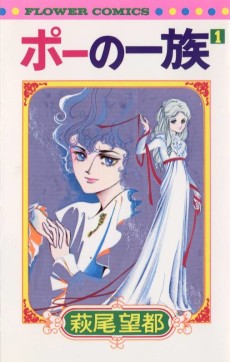 MANGA SupernaturalPoe no Ichizoku
SCORE
MORE INFO
Ended inJune 1, 1984
Favorited by 11 Users