
BUDDHA
STATUS
COMPLETE
VOLUMES
14
RELEASE
November 1, 1983
CHAPTERS
69
DESCRIPTION
Osamu Tezuka’s vaunted storytelling genius, consummate skill at visual expression, and warm humanity blossom fully in his epic volumes on Siddhartha’s life and times. Tezuka evidences his profound grasp of the subject by contextualizing the Buddha’s ideas; the emphasis is on movement, action, emotion, and conflict as the prince Siddhartha runs away from home, travels across India, and questions Hindu practices such as ascetic self-mutilation and caste oppression. Rather than recommend resignation and impassivity, Tezuka’s Buddha predicates enlightenment upon recognizing the interconnectedness of life, having compassion for the suffering, and ordering one’s life sensibly. Philosophical segments are threaded into interpersonal situations with ground-breaking visual dynamism by an artist who makes sure never to lose his readers’ attention.
(Source: Kodansha USA)
Note: Won the Bungei Shunju Manga Award in 1975 and the Best U.S. Edition of International Material for the Eisner Award in 2004 and 2005.
CAST
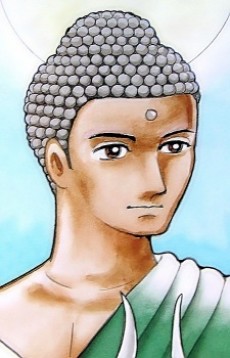
Siddhartha Gautama

Tatta

Shunsaku Ban

Housuke Sharaku
CHAPTERS
RELATED TO BUDDHA


REVIEWS

Krankastel
Siddharta meets Tezuka; an original retelling of an important lifework.Continue on AniListSummarizing Osamu Tezuka’s Buddha, it is a historical epic with biographical and some supernatural elements (connected to Vedic religions and mythology), on Siddhartha Gautama‘s lifework. Not a biography though; some characters are fictional, the story starts before Siddhartha’s birth and Tezuka also took another kind of artistic license.
However, the manga never deviates from Buddhist teachings. Also, Tezuka’s storytelling was straightforward and easy to grasp, for all its philosophical, societal and religious themes, with fine balance between narration, dialogue-based storytelling and visual storytelling.
__[1. Beginning with the story…]__ 
The first chapter mentions the Indo-Aryans of the Vedic period, who introduced exploitative and oppressive discrimination with four social classes: brahmin (priest class), rajanya/kshatriya (ruler class), vaishya (merchant class) and shudra (laborer class), thus initiating readers to social injustices and hardships of ancient India and how these pushed people towards alternative paths for spiritual enlightenment.
Immediately after this introduction, the story shifts to a magnificent sample of purely visual storytelling: an old monk collapses on a snowy mountain, and a bear, a fox and a rabbit seek food for him. The rabbit fails to do so, and after the old man lights a campfire, it throws itself into it to offer itself as food.
And right after this iconic scene, the narrative shifts to the tale of a shudra boy who after certain circumstances is raised and trained as a kshatriya. Its importance permeats the rest of the narrative, and also introduces the “untouchables” outside the “varna” system, and showcases social injustice being the root of many evils. After this interjecting tale, the rest of the narrative continues with the birth and growth of Siddharta, and ends at the Mahaparinirvana.

More and more characters are introduced and recurring ones are developing accordingly, interconnected to the narrative. More details will be noted on [2.], the character section. And one closing note: Osamu Tezuka’s artistic license was highly connected to visual storytelling. He included certain comedic, metafictional and intertextual elements typical of his writing style, that contrasted heavily with the mature and often dark story; this is one of the aspects that might make-or-break the show for a reader. More details will be noted on [3.], the artwork section.
__[2. Continuing with the characters…]__ 
Although Siddhartha is born a kshatriya according to the varna system, he could not understand why humans must suffer and on what basis social classes and untouchables must exist to begin with. After eventually rejecting his varna, homeland and family, he sets out on a journey as a travelling monk. From the journey’s start and up until Mahaparinirvana, his character is constantly dynamic: he observes nature and mankind and introspects. He suffers and witnesses suffering in equal measure. He is tempted yet never yields to base nature, and gradually learns more and more on nature and life, culminating in receiving enlightenment. But his struggle does not end, he devotes the rest of his life into teaching.
Let’s retrace to how I mentioned that social injustice was the root of MANY evils, tied to material hardship. The other side of the evils is connected to spiritual hardship: suffering (dukkha) according to Buddhism originates from being unsatisfied because of desire/greed, distress due to pains of living (e.g. aging and dying) and distress due to impermanence. Siddhartha advocates bringing dukkha into an end, by renouncing desire and embracing truths of the world, and ourselves as threads of a grand tapestry.

Siddhartha attracts people from all walks of life, including “untouchable” bandits and shudras desperate for spiritual guidance to brahmins who antagonize him to kshatriyas in fear and denial of death. Some embrace his teachings and attempt to change their lifestyle and mindset, whereas others deny his teachings and/or act antagonistically towards him, and fall into tragedy. They are not always complex characters (some are rather flat) and often act immorally, but their struggles are (mostly) tied both to values dissonance and to the hardships they endure. Their interactions with the Buddha and each other drive the narrative together in perfect harmony.
__[3. And concluding with the artwork…]__ From the point of manga history, Buddha is considered a sample of the gekiga movement. Unlike Astro Boy that catered towards children during the 50s and 60s, Buddha is a sample of early 70s that catered towards older teenager and adult audiences, some of whom might have grown up reading early manga.
Before building on this statement, I must describe how Buddha remains a “Tezukan” work. First, character designs remain cartoony (strongly influenced by Disney), as is the case with the e.g. Astro Boy and Dororo, contrasting with the mature story.

Second, let’s retrace to the end of section [1.]: an aspect of visual storytelling can be a hit-or-miss element. To elaborate, quite some designs are caricatural and there are visual anachronisms (e.g. cigarettes flying), direct references on media/producers/works (e.g. ET the Extra Terrestrial) and fourth-wall breaking (e.g. an avatar of Tezuka self-deprecating, or panel-connected humor). To be honest, I had a mixed-negative opinion on this aspect occasionally, for it caused mood dissonance and excessive contrasts with the mature tone. However, Buddha’s narrative is by no means undermined, and if this aspect is overlooked or embraced, one may even appreciate Tezuka’s visual craftiness.
Retracing to gekiga; the visual storytelling also remains true to the movement by being highly cinematic and more "adult”. For example, paneling is connected to meta jokes, but also to some of the smoothest scene transitions, I could always tell how parts of the narrative are interconnected without ever being confused. Panels don’t follow the same format and depending on their size and patterns, important parts are highlighted in juxtaposition to the rest of the scene. Close-ups and powerful visual shots (e.g. Siddhartha’s birth) are presented at perfect timing to make for memorable scenes.
Last but not least be warned: there are many graphic scenes (e.g. burnt corpses or showcasing smallpox), female nudity is commonplace (different modesty standards) and for all the occasional goofiness, Tezuka pulled no punches in viscerally portraying cruel aspects of nature and life, such as drought and starvation.
Hope you enjoyed my review! 
CarroRebaixado
Osamu Tezuka and BuddhaContinue on AniList
A Short Review of Osamu Tezuka Buddha

The manga Buddha is a biography of Siddhartha Gautama, the renowned spiritual teacher and founder of Buddhism. Contrary to many other works, however, the Buddha himself remains a secondary character for much of the story. Tezuka masterfully foregrounds the people, customs, sins, social problems, and natural world that gave rise to this new philosophy, this new way of understanding life, so different from how people in India and the rest of the world viewed the universe.
Themes, World, and the Birth of Buddha


In the first volume, the titular character has not yet been born. Instead, we follow the adventures of a slave boy trying to rise through the caste system by becoming a soldier and helping his mother, as well as Tata, an innocent child from a caste considered even lower than that of slaves, who possesses the power to enter the minds of animals. Although their fates are ultimately tragic, this section introduces the reader to the world into which these characters are born: a society rich in culture, burdened by crippling prejudice, surrounded by breathtaking nature, and marked by immense violence.
From the Buddha’s birth to his death, he encounters people from every walk of life, from the lowest castes to the highest, from followers of rival philosophies to Zoroastrian priests, and none of them are portrayed as saints. The Buddha himself is depicted in a morally ambiguous light. His journey toward enlightenment brings great suffering to those around him and to his own family, as he abandons his father, mother, wife, son, and people, leaving them without a leader, a decision that ultimately condemns many of them to slavery and death.


Nature is as important as the people in shaping the Buddha’s mind. It is portrayed as sacred and immaculate, and Tezuka’s artwork captures it beautifully. Trees, rivers, clouds, mountains, waterfalls, animals, and insects all play important roles in the story. After all, the Buddha attains enlightenment while meditating beneath a tree, and in this version of the story, his first disciples are deer, who in turn become his teachers.
The change the Buddha seeks to bring to the world is met by its most formidable opponent: human nature, shaped by the social conditions of the time. Enlightenment is not portrayed as a magical, all-solving force capable of healing the world. Even after becoming enlightened, the Buddha makes mistakes, doubts himself, and continues to learn how to teach and communicate. Even after mastering these skills, he still fails. His teachings, although profound, are not always enough. Even when they reach someone’s heart and inspire genuine devotion, that alone is often insufficient, as some people continue to perpetuate violence, whether out of custom or a desire for revenge.
This immensely complex situation demonstrates that, despite everything, the Buddha remains human, and that transforming a society is not something that can be accomplished quickly. The task he takes upon himself is greater than he is, even at his noblest. Through all these problems, all this suffering, and all this learning and failure, Tezuka makes it clear that striving for a better world is worthwhile, even if it means changing one person at a time. The story is a profound tragedy and never shies away from that reality. You will come to care for its characters and feel genuine sorrow when they meet their end.


Tezuka Art


Osamu Tezuka’s artwork, as expected, is amazing. He is a master of conveying dynamism through movement and facial expressions, and he is equally skilled at capturing the beauty of India’s natural landscapes. His fight scenes, although brief, are always a pleasure to watch. They are straightforward, and every movement is rendered with clarity and detail.


Conclusion
Buddha is a monumental work. It may not be the most accurate biographical account, but it was never intended to be. As Tezuka himself said, it should be read in much the same way as science fiction.

SIMILAR MANGAS YOU MAY LIKE
 MANGA DramaHi no Tori
 MANGA DramaHidamari no Ki
 MANGA DramaBlack Jack
 MANGA Slice of LifeBuddha no Kotoba Sutta Nipata
 MANGA DramaAkkanbe Ikkyu
 MANGA ActionDragon Ball




SCORE
- (4.1/5)
MORE INFO
Ended inNovember 1, 1983
Favorited by 292 Users